GEO guides
How to Track AI Search Visibility in 2026: A Practical Guide for Businesses
Search is changing and so is the way customers discover businesses.

By Geolytic · · Updated · 17 min read
A few years ago, someone looking for business software would typically search Google, open several websites and compare their options. Today, that same person can ask ChatGPT or Perplexity for recommendations and receive a shortlist almost immediately.
For businesses, this raises an important question: Is your brand appearing in those conversations?
AI search visibility measures how often your brand appears in AI-generated answers, how prominently it is recommended and whether your website is cited as a source.
Understanding that visibility is becoming an important part of modern search marketing. Your website might perform well in Google search results but still be missing from the answers potential customers receive through ChatGPT, Google AI Overviews or Perplexity.
This guide explains how to track your presence across AI search platforms, measure the metrics that matter and identify opportunities to improve your visibility.
What Is AI Search Visibility?
AI search visibility describes how discoverable your brand is when people use AI-powered tools to research products, compare services or find answers.
Traditional SEO focuses heavily on where your pages appear in search results. AI search introduces another dimension: whether your business is mentioned or recommended within an answer generated by an AI system.
Imagine someone asks ChatGPT:
“What are the best customer analytics platforms for a growing SaaS company?”
The response might recommend five companies, explain their strengths and link to relevant sources.
If your brand appears in that response, you’ve gained visibility with a potential customer. If your company isn’t mentioned, you may have missed an opportunity to enter their consideration set.
But visibility isn’t simply about getting your name into an answer. The way your business is described matters just as much.
A brief mention at the bottom of a long response isn’t equivalent to a detailed recommendation that explains why your product is a good fit.
That’s why meaningful AI visibility measurement needs to look beyond mentions alone.
What Should Businesses Actually Measure?
There are several useful ways to understand your presence in AI search.
| Metric | What it tells you |
|---|---|
| Brand mentions | How frequently AI tools mention your company |
| Website citations | How often your content appears as a linked source |
| Recommendation prominence | How strongly your business is featured in an answer |
| AI share of voice | How your visibility compares with competing brands |
| Brand sentiment | Whether your company is described positively, neutrally or negatively |
| Answer accuracy | Whether AI-generated information about your business is correct |
| Referral traffic | Whether identifiable AI search visits lead to engagement or conversions |
Together, these measurements provide a clearer picture of your brand’s position in AI-powered discovery.
Why Does AI Search Visibility Matter in 2026?
AI search visibility matters because customers can now research businesses and evaluate products without following the traditional search journey.
Someone comparing software platforms may receive a detailed answer before ever visiting a vendor’s website.
That doesn’t mean traditional search is disappearing. Google remains an important discovery channel and established SEO practices continue to matter.
What has changed is the number of places where customers can form opinions about your business.
What Does the Research Say?
The shift toward AI-assisted search is supported by several widely cited studies.
In February 2024, Gartner predicted that traditional search engine volume would decline by 25% by 2026 as AI chatbots and virtual agents became more widely used.
That figure was a forecast rather than a confirmed measurement of what happened in 2026. Even so, it highlighted how quickly expectations around online discovery were changing.
Source: Gartner’s search engine forecast.
Research from Pew Research Center in July 2025 offered another important insight.
The study found that users clicked traditional search links in 8% of observed Google searches featuring AI summaries, compared with 15% of searches without an AI summary.
Links appearing directly within AI summaries received clicks in approximately 1% of the observed searches that included them.
These findings don’t prove that AI summaries caused every difference in user behaviour. However, they demonstrate why visibility and website traffic should be measured separately.
Source: Pew Research Center’s study of AI summaries and search behaviour.
For marketing teams, the implication is straightforward.
A customer can discover your brand through an AI-generated answer without visiting your website immediately.
If you’re measuring success exclusively through organic clicks, you may be missing part of that discovery process.
How Can You Check Whether Your Brand Appears in ChatGPT?
The simplest way to start tracking your brand in ChatGPT is to test the questions your customers are likely to ask.
You don’t need a complicated analytics setup to begin. What you do need is a consistent method.
Start by thinking about how potential customers research your industry.
For example, imagine you run a B2B analytics company. Your prospective customers might ask:
- What are the best analytics platforms for small businesses?
- Which reporting tools work well with Salesforce?
- What are the most affordable enterprise analytics solutions?
- Which alternatives to Power BI are worth considering?
- What reporting software is suitable for UK financial services companies?
These questions are more useful than simply asking ChatGPT to describe your business.
They reveal whether your company appears when someone is actively exploring their options.
How Should You Record the Results?
For each question, note whether ChatGPT mentions your company, recommends it and includes a link to your website.
Also record which competitors appear.
The date and testing conditions matter because AI-generated responses can change. A company mentioned today may not appear in the same answer next week.
Rather than drawing conclusions from one response, repeat important questions over time.
A simple tracking sheet could look like this:
| Customer question | Your brand mentioned? | Website cited? | Main competitor mentioned? |
|---|---|---|---|
| Best analytics tools for small businesses | Yes | No | Competitor A |
| Best reporting software for enterprise teams | No | No | Competitor B |
| Alternatives to a leading analytics platform | Yes | Yes | Competitor C |
| Analytics software for UK companies | No | No | Competitor A |
This example uses fictional observations.
The real value comes from collecting the same information consistently.
If your brand regularly disappears from commercially important questions, you’ve identified an area worth investigating.
That doesn’t automatically mean your website has a technical problem. Your competitors may have stronger content, more relevant product capabilities or better independent coverage.
A proper Generative Engine Optimization audit helps distinguish between those possibilities.
How Do You Track Your Website in Google AI Overviews?
Google AI visibility can be measured through Google Search Console alongside your existing website analytics and carefully selected search queries.
One important development in 2026 was the introduction of dedicated generative AI performance reporting in Search Console.
According to Google’s documentation, the Generative AI performance report provides information about eligible website impressions in AI Overviews and AI Mode.
This gives website owners a more direct way to understand some of their exposure within Google’s AI search experiences.
Which Data Should You Look At?
Start with the pages receiving generative AI impressions.
Then examine how exposure varies by country, device and reporting period.
For companies operating in both the US and UK, geographic comparisons can be especially useful.
Customers in different markets may search for the same service using different terminology or have different regulatory and purchasing requirements.
A US software buyer might prioritise one set of integrations while a UK company may be particularly concerned with GDPR compliance or local service availability.
Understanding these differences can help you decide which pages need more detailed information.
Google’s generative AI reporting is valuable but remember that it covers Google’s supported search features. It doesn’t tell you how often ChatGPT or Perplexity recommends your brand.
Those platforms still need separate analysis.
You can find the reporting details in Google’s official Search Console documentation.
How Can You Track Brand Mentions in Perplexity?
Perplexity provides another useful perspective on AI search because its answers frequently include links to supporting sources.
To evaluate your brand’s visibility, ask questions relevant to your industry and examine both the recommendations and the references.
Suppose someone asks Perplexity to compare the best cybersecurity platforms for small businesses.
Your company might appear as a recommended provider. It might also be mentioned in a third-party comparison article linked within the response.
These are two different kinds of exposure.
The first shows that your brand appeared in the answer. The second shows that a particular source was cited.
Pay attention to both.
A reputable industry publication discussing your product may contribute useful information about your business, even when the AI answer doesn’t cite your own website.
This is one reason GEO extends beyond technical website optimisation.
Your wider online reputation matters too.
However, don’t assume that appearing in a cited article automatically caused your brand to be recommended. AI retrieval and response generation involve multiple factors that are not always visible to website owners.
Focus on what you can observe and verify.
What Are the Most Important AI Search Visibility Metrics?
If you’re reporting AI search performance to a marketing director or business owner, a handful of well-defined metrics will usually tell you more than dozens of complicated charts.
The goal isn’t to collect data for its own sake. It’s to understand where your brand is visible, where competitors are winning attention and what needs to improve.
How Do You Calculate Brand Mention Rate?
Brand mention rate measures the percentage of tested AI responses that include your company.
The calculation is straightforward:
Brand Mention Rate = (Responses mentioning your brand ÷ Total valid responses) × 100
Let’s say you test 100 relevant customer questions and your company appears in 35 answers.
Your observed brand mention rate is 35%.
This doesn’t mean your brand appears in 35% of every AI search across the internet. It means your company appeared in 35% of the responses within your chosen test sample.
That distinction matters, especially when presenting results to senior management.
What Is AI Citation Rate?
AI citation rate measures how often the responses you test include a link to your website.
For example, if your domain is cited in 20 of 100 tested responses, your citation rate is 20%.
A mention without a citation can still create awareness but a citation offers an additional opportunity for someone to visit your website and explore your content.
It’s worth tracking which specific pages receive citations.
You may discover that your original research attracts more references than your product pages.
That insight can influence your future content strategy.
How Do You Measure AI Share of Voice?
AI share of voice compares your brand’s presence with a defined group of competitors.
Imagine that you’re monitoring four software companies across a consistent set of AI search questions.
Your results might look like this:
| Company | Recorded mentions | Share of tracked mentions |
|---|---|---|
| Your company | 40 | 40% |
| Competitor A | 30 | 30% |
| Competitor B | 20 | 20% |
| Competitor C | 10 | 10% |
These are illustrative numbers rather than actual market data.
The metric helps you see how your company performs relative to the brands customers are likely to consider alongside yours.
Be careful with the interpretation.
AI share of voice doesn’t have one universally accepted calculation. Different tools may use different query sets, weighting methods and counting rules.
When comparing results, make sure you understand how the numbers were produced.
Why Does Recommendation Quality Matter?
Not every mention has the same value.
Consider the difference between these two hypothetical answers.
The first says:
“Other options include Company A, Company B and Company C.”
The second says:
“Company A is worth considering for teams that need flexible reporting and straightforward CRM integrations. Its strongest fit is with growing businesses that want an accessible analytics platform.”
The second answer gives a potential customer much more information.
This is why it can be useful to measure recommendation prominence or visibility depth.
A brand might appear in fewer answers but receive more substantive recommendations when it does appear.
You should also check whether those recommendations are accurate.
A detailed but incorrect description can create problems rather than opportunities.
How Do You Build an Effective AI Search Visibility Dashboard?
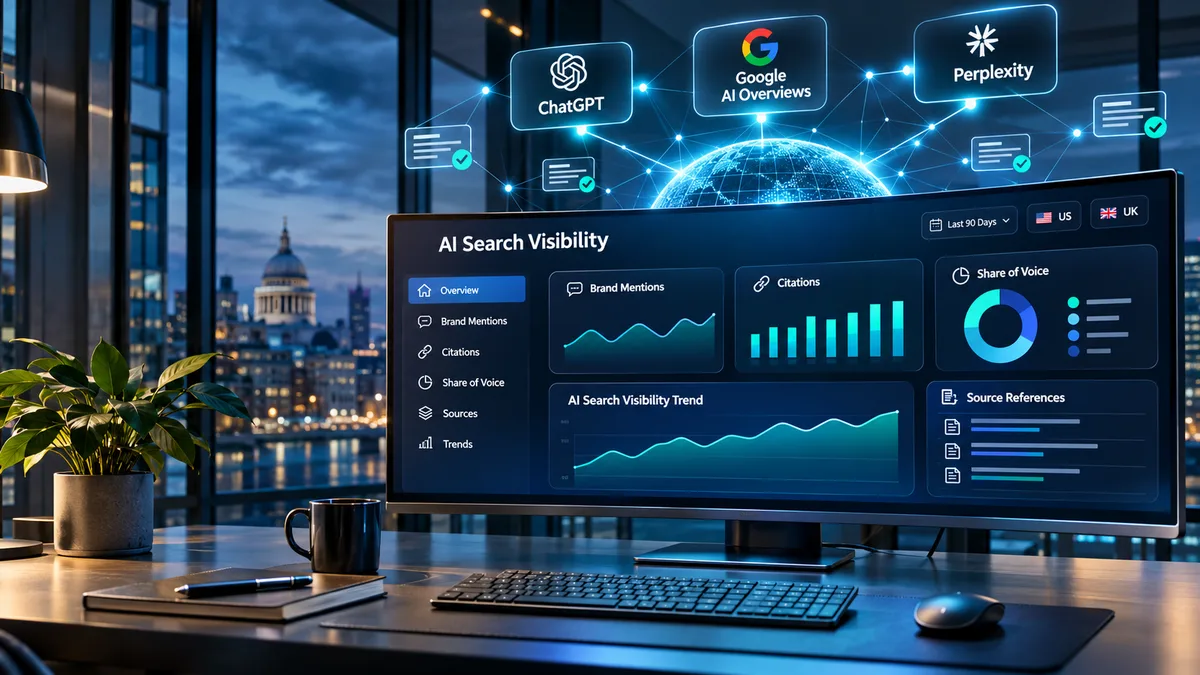
A useful AI search dashboard brings your most important measurements together so you can monitor trends and decide where to focus your efforts.
You don’t need to begin with an expensive enterprise system.
A spreadsheet can work for a small initial study. As the number of prompts, competitors and markets grows, manual tracking becomes harder to maintain.
At that point, a dedicated GEO analytics workflow becomes more valuable.
What Should Your Dashboard Include?
A well-designed dashboard should answer a few practical questions.
How often is your brand appearing in AI-generated responses?
Which competitors are being recommended more frequently?
Are AI tools linking to your website?
Are the descriptions of your company accurate?
And perhaps most importantly, is your visibility improving over time?
For marketing directors, the dashboard should also distinguish AI search exposure from actual commercial performance.
An increase in mentions is encouraging but it doesn’t automatically mean more customers or higher revenue.
Where identifiable referral data is available, connect it with website engagement, lead generation and conversion reporting.
Where Does Geolytic Fit Into This Process?
This is where an audit-focused platform such as Geolytic becomes relevant.
Geolytic is designed around Generative Engine Optimization audits and AI search visibility analysis. Its audit crawls your site and links each finding to the affected page. On paid plans, saved buyer questions are sent to Gemini, an OpenAI model and Claude through their official APIs and each answer is stored with any brand mentions. These are API answers rather than consumer app results and Perplexity is not checked.
For businesses exploring GEO, the first challenge is often understanding the condition of their existing website.
Are important pages accessible? Does the site communicate its expertise clearly? Is the content structured around useful information? Are there technical problems that could affect discoverability?
A structured GEO audit provides a foundation for answering those questions. Our GEO audit guide walks through the process and the free AI bot crawlability checker tests crawler access on any page.
It also helps marketing teams move away from guesswork and concentrate on improvements supported by actual findings.
When evaluating any GEO platform, look closely at the evidence behind its recommendations. Clear explanations and verifiable issues are more useful than an unexplained visibility score.
How Can You Improve Your Brand’s Visibility in AI Search?
Improving AI search visibility starts with making your website more useful, accessible and credible.
There’s no reliable shortcut that guarantees your business will be recommended by ChatGPT or another AI search platform.
However, there are practical improvements worth making.
Publish Content That Answers Real Questions
Look at the questions customers ask before choosing a product or service.
Are those questions answered clearly on your website?
For example, if people regularly compare your software with a competitor, a balanced comparison page may be genuinely useful.
Explain the differences between the products, who each solution is suitable for and where the limitations are.
Avoid making every comparison a sales pitch.
Clear and accurate information is more valuable than exaggerated claims.
Original research, detailed guides and practical case studies can also strengthen your website.
The objective is to publish material worth referencing, not simply produce more pages.
Make Important Information Easy to Find
Check that search engines and relevant crawlers can access your important content.
Review your robots.txt file, canonical URLs, indexing instructions and internal links.
Make sure important information isn’t hidden behind broken scripts or inaccessible page elements.
OpenAI provides information about its search crawler, OAI-SearchBot, in its official crawler documentation.
Allowing relevant crawler access can support discoverability but it doesn’t guarantee that your pages will appear in AI-generated answers.
Strengthen Your Brand’s Online Reputation
Your website isn’t the only place where information about your business exists.
Potential sources include professional directories, industry publications, independent reviews and trusted partner websites.
Make sure descriptions of your company are accurate and consistent wherever they appear.
If your product has changed, update outdated documentation and public profiles where you can.
Look for genuine opportunities to contribute expertise to industry discussions.
Strong brand authority develops through useful information and credible evidence, not artificial mentions or fabricated reviews.
Keep Your Content Accurate
Outdated information can create unnecessary confusion.
Check important product pages, pricing information, feature descriptions and company details regularly.
If an AI assistant repeatedly describes a feature your product no longer supports, investigate where that information may be coming from.
A visibility audit becomes far more valuable when it helps you identify errors that could affect customer trust.
How Often Should You Monitor AI Search Visibility?
For most businesses, monthly monitoring is a practical starting point.
It gives you an opportunity to identify changes without overreacting to normal variation in AI-generated answers.
Companies operating in competitive markets may choose to monitor their most important commercial questions more frequently.
The key is consistency.
If you change your prompts, competitors or testing method every week, comparing results becomes difficult.
Maintain a core set of questions so you can understand how your visibility changes over time.
You can expand that set when new products launch or customer priorities change.
How Can You Create a 30-Day AI Visibility Plan?
A month is enough to establish an initial baseline and identify practical improvements.
It may not be enough to prove that every change has had a measurable effect, particularly when AI responses and search indexing evolve over time.
Here’s a reasonable way to begin.
| Timeline | Focus | Expected outcome |
|---|---|---|
| Week 1 | Research customer questions and identify competitors | A relevant set of prompts to monitor |
| Week 2 | Test AI search platforms and review website accessibility | Initial visibility findings |
| Week 3 | Review citations, content gaps and incorrect brand information | A prioritised improvement plan |
| Week 4 | Make initial improvements and repeat selected tests | A baseline for ongoing reporting |
Keep a record of what changes on your website and when.
That makes future analysis more meaningful.
If visibility improves after a particular update, you can investigate the relationship. Just avoid assuming that every observed change was caused by your most recent edit.
What Are the Biggest Mistakes Businesses Make With AI Search Tracking?
One of the most common mistakes is assuming that an AI-generated answer behaves like a fixed Google ranking.
It doesn’t.
AI systems can produce different answers depending on the question, available sources and testing conditions.
A single mention isn’t proof of lasting visibility. Similarly, one missing recommendation doesn’t mean your website is invisible everywhere.
Another common mistake is focusing entirely on positive sentiment.
A company may receive a favourable description that includes incorrect product information. That isn’t necessarily a successful outcome.
Accuracy deserves just as much attention as visibility.
Businesses should also avoid comparing results from incompatible tools without understanding their methods.
One platform might count every mention. Another might count only recommendations. A third might use weighted scores.
Those numbers aren’t automatically comparable.
Good GEO reporting depends on transparent measurement rather than impressive-looking percentages.
Frequently Asked Questions About AI Search Visibility
Can I Find Out Whether ChatGPT Recommends My Business?
Yes. You can test relevant customer questions in ChatGPT and record whether your business appears. Repeated tests provide a more useful picture than relying on a single response.
Is AI Search Visibility the Same as SEO?
No, although the two are closely connected.
SEO focuses on improving visibility in search engines. GEO and AI visibility measurement extend that work to how brands and information appear in AI-generated responses.
Many technical and content improvements benefit both areas.
Can Google Analytics Track ChatGPT Visitors?
Website analytics can identify some visits referred from ChatGPT and other AI services when referral information is available.
However, analytics won’t capture every occasion when someone sees your brand in an AI-generated answer without visiting your website.
What Is a Good AI Visibility Score?
There isn’t a universal benchmark.
A useful score depends on your industry, the competitors you’re tracking and the questions included in your analysis.
Focus on clearly defined measurements and improvements over time.
Does AI Search Visibility Help Generate Leads?
AI-generated recommendations may introduce potential customers to your business and influence their research.
However, visibility alone doesn’t prove that leads or sales have increased.
Use website analytics and CRM reporting to evaluate identifiable commercial outcomes.
Do I Need a GEO Audit if My Website Already Ranks Well?
A GEO audit can still be useful.
Strong Google rankings don’t automatically reveal how your company is represented in ChatGPT, Perplexity or other AI search experiences.
An audit can help identify differences between your traditional search performance and your observed AI visibility.
How Can You Start Improving Your AI Search Visibility Today?
You don’t need to overhaul your entire marketing strategy to begin.
Start with a simple question: What happens when a potential customer asks an AI assistant to recommend a business like yours?
Test a few relevant questions. Look at the companies being recommended and the sources being cited.
Then examine your own website.
Does it explain what you offer clearly? Is important content accessible? Are your claims supported by reliable information? Can customers easily understand why your business might be suitable for them?
These are useful questions regardless of how search technology evolves.
For businesses already investing in SEO, GEO represents an opportunity to understand an additional part of the customer discovery journey.
The aim isn’t to chase every new AI search trend. It’s to make your company easier to discover and easier to evaluate wherever customers are looking for answers.
Start With a GEO Audit From Geolytic
If you’re unsure where your website stands, a structured audit is a sensible first step.
Geolytic helps businesses explore their Generative Engine Optimization readiness through website auditing and AI search visibility analysis.
It provides a starting point for identifying technical issues and understanding where your website may need improvement.
Rather than making changes based on assumptions, you can begin with a clearer picture of your site’s current condition.
Want to see how prepared your website is for AI-powered search?
To see how Geolytic records brand mentions in AI answers, read about the AI search visibility checker. Explore Geolytic and start your GEO audit
Understanding where you stand today is the first step toward building a stronger search presence tomorrow.
Sources and Further Reading
The following sources provide additional background on AI search behaviour, website discoverability and GEO measurement.
- Gartner: Search Engine Volume Forecast and AI Chatbots
- Pew Research Center: How AI Summaries Affect Search Behaviour
- Google Search Central: Optimizing for Generative AI Features
- Google Search Console: Generative AI Performance Report
- OpenAI: Web Crawlers and Search Discovery
Explore your website’s AI visibility with Geolytic
Start with a free readiness check. Paid plans add saved buyer questions answered through official AI model APIs.